|
|
|||||||
|
|
|
|
|
|
|
|
|
|
|
|
|
|
|
|
|
|
|
Zeal Speculator is our acclaimed weekly newsletter for active speculators. It is usually published late Tuesday afternoons, about an hour after US stock markets close. With its narrow single-week focus, Zeal Speculator digs far deeper into both individual-stock analyses of our open trades and every trading day's price action. Our famed contrarian analysis of sentiment, technicals, and fundamentals on a day-by-day basis greatly deepens speculators' understanding of the opportunities and risks existing in individual trades and the current markets.
With the markets endlessly variable and fascinating, ZS necessarily covers a wide array of topics. It's hard to understand the sheer depth, breadth, quality, and efficacy of our famous contrarian research until you've been reading for at least a year. But this tour will give you an idea of what to expect with the actual June 1, 2021 issue. It covered a spring week where young uplegs in gold and its miners' stocks were gathering steam, fueling mounting gains for contrarian traders. Gold investment demand was returning as monetary inflation soared.
ZS counters this natural tendency by digging deeply into each trading day's price action, detailing what's actually driving the markets by motivating traders to buy and sell. Understanding how market events unfold is essential, since price action is a causal chain extending into the future. Event A leads to B then C then D. So each issue of ZS is built around an essential chronological skeleton of events.
Speculators can't understand where markets are likely heading next without first knowing why they got where they are. We draw on our unparalleled experience, knowledge, and wisdom forged from decades of intensely studying and actively trading the markets to illuminate each day's action. We drill down on anything noteworthy, enhancing your perspective with the latest data and market history.
A classic Warren Buffett quote on the ZS masthead reflects our studied contrarian trading philosophy. Market history has proven the best way to consistently buy low and sell high is to do the opposite of what is popular. This means buying low when things are out of favor, before later selling high when they're popular again. The key to executing this is carefully monitoring herd sentiment, then making opposing trades. A core focus of ZS is watching prevailing market psychology, since it is usually the dominant driver of most short-term price action.
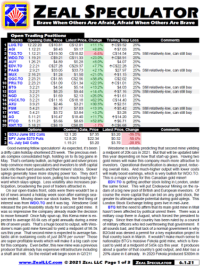
The ultimate mission of all our market analysis is executing profitable trades to multiply wealth, so all our labors work towards that. Page 1 leads with our current ZS trading book, including all open positions along with any new ones being added. Unlike most analysts, we actually walk the walk and risk our own hard-earned capital in our trades. Their performance determines our newsletter business's success. A full book consists of 20 stock trades, with capital allocations initially targeted around an equal 5% in each to maintain prudent diversification.
We attempt to time our trades based on broader-market conditions that drive major trends. We strive to buy low when nearly everyone else is scared, then later sell high when prevailing sentiment shifts to euphoria. But exact bottoms and tops are never knowable until well after the fact, the markets are a probabilities game. So we gradually layer in and out of trading campaigns to attempt to straddle those major reversals. Our trading tempo varies from week to week depending on how favorable the real-time odds appear for buying and selling.
We aggressively add new positions when fundamentally-superior individual companies' stock prices are trading relatively-low. But when prices are high, we abstain. Each trade's stock symbol, opening date and price, latest price, and the overall gain or loss since recommendation are shown. Those are followed by the latest trailing-stop-loss levels and their percentage declines allowed before tripping. Running trailing stops is essential to mitigating risks, letting winning trades run as long as possible while cutting losses before they grow excessive.
The target time horizon for ZS trades centers around 6 months, although we do hold some trades longer. That grants enough time for major trends to mature and overcome the incessant day-to-day market noise, and witness stocks accrue big gains. Since maintaining full public accountability is very important, once a quarter the results of all realized trades are fully tracked and published in our performance results. Our decades of average annualized gains have rivaled great hedge funds, helping our subscribers multiply their wealth rapidly.
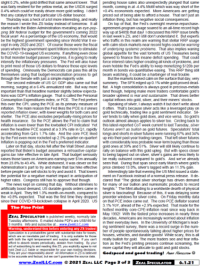
Each week's ZS analysis begins with the latest material news reported by each of our open stock trades. It is important for speculators to stay abreast of recent corporate developments, as they can really move stock prices higher or lower. That discussion on individual companies' fortunes is followed by our day-by-day look at what is driving markets and why. The space allocated to each focus shifts depending on how much news flow is coming from our trades. That surges dramatically during quarterly earnings seasons, then wanes in other times.
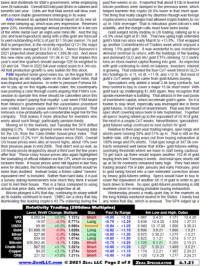
Our famed contrarian market analysis hung on the framework of each month's chronology is shared by Relativity Trading multiples on Page 2. This is a powerful and elegant trade-timing tool based on Adam Hamilton's Relativity Trading methodology. Oversold and overbought conditions, ideal times to buy low and sell high, are defined off evolving baselines formed by 200-day moving averages.
Absolute price levels are usually far less important than how fast a price got to prevailing levels. Anything that rallies too far too fast sparks too much greed, which soon burns itself out leading to a sharp correction. And anything plunging too fast spawns too much fear, soon exhausting sellers leading to a sharp rally. Trading these contrary reversals requires empirically defining "too far too fast".
Relativity accomplishes this mission by recasting prices as multiples of their own 200dmas. As these multiples tend to form horizontal trading ranges over time, they're an excellent indicator of prices extending too high or too low to likely be sustainable over the near-term. Explained in depth in our tutorial page, these multiples help investors succeed in fighting the crowd to buy low and sell high. Buy-low opportunities arise when prices fall near or under their 200dmas, while sell-high warnings flash when prices stretch far above those baselines.
After many tens of thousands of hours of total market immersion, our knowledge is world-class. It enables us to deftly weave a tremendous amount of research, historical precedent, real-world trading experience, and common sense into each week's price action. As your knowledge of the markets and what's driving them grows, so will your ability to harness greed and fear to multiply your wealth.
Our studied and insightful contrarian analysis deftly weaves everything going on in the markets into a coherent and logical whole, helping speculators successfully navigate the emotional minefield of chaotic day-to-day action. An understanding of why things are happening illuminates probabilities governing near-future price action, which can then be successfully traded as good opportunities arise.
Zeal Speculator offers incredible value for your hard-earned money. Few other newsletters in the world really walk the contrarian walk, bucking popular greed and fear with actual trades. ZS will greatly help you cultivate that essential contrarian perspective necessary to thrive in the markets. It is carefully researched and written by a lifelong active speculator for other active speculators. ZS will make you smarter and keep your emotions in check. Subscribe today and put our extraordinary experience, knowledge, and wisdom to work for you! |
|||||||
|
|
|
|
|
|
|
|
|
|
|
|
|
|
|
|||