|
|
|||||||
|
|
|
|
|
|
|
|
|
|
|
|
|
|
|
|
|
|
|
Silver Defies Bust Adam Hamilton April 24, 2026 2538 Words
Silver has proven remarkably resilient in recent months. After rocketing parabolic in late January, silver had largely finished another boom-bubble-burst-bust cycle. While the initial three stages were textbook-perfect, silver has since defied a classic bust. Silver’s impressive staying power so far at still-really-high levels compared to pre-boom ones is quite bullish, suggesting silver is revaluing to a much-higher price regime.
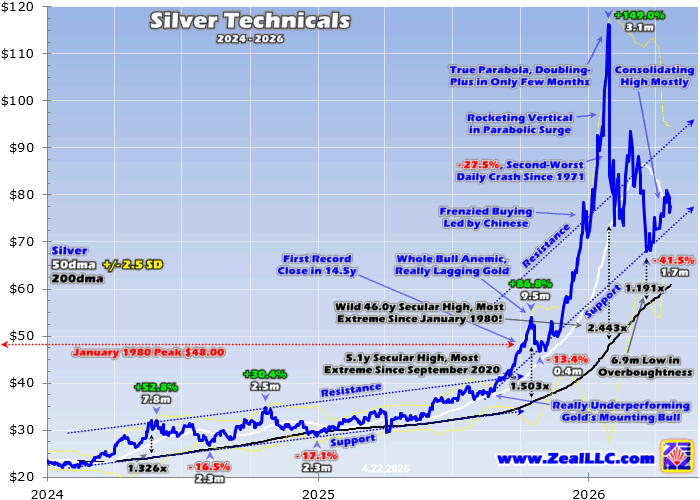
From late October 2025 to late January 2026, silver skyrocketed an astounding 149.0% in just 3.1 months! I warned about silver’s extreme parabola in a mid-January essay a couple weeks before that dangerous bubble burst. Just one week before that reckoning, we fought the hyper-euphoric herd to add SLV-silver-ETF put options in our weekly newsletter. Those would later prove profitable after that mania failed.
Based on my long historic studies of parabolic extremes, I define them as doublings within two-to-three months following massive bull runs. Silver certainly fit that bill by mid-January. At its nose-bleed apex on the 28th, silver had soared a jaw-dropping 144.3% above its baseline 200-day moving average! That was the most-overbought silver had been since mid-January 1980’s notorious bubble climax fully 46.0 years earlier!
A nearly-half-century overboughtness extreme is nothing to be trifled with. The day after silver peaked in mid-January 1980, it crashed a brutal 25.0%! And over the next 2.2 months, silver’s total bust extended to a soul-crushing 76.9%! Booms are great, but bubbles necessitate bursts followed by busts. Parabolic moonshots are the most-dangerous times in markets, as greed-fueled overheated prices crater soon after those.
Indeed silver closely followed that boom-bubble-burst-bust script out of late January 2026’s epic peak. In a single day, silver crashed a catastrophic 27.5%! That ranked as its second-largest down day since 1971, only narrowly trailing a 30.8% monster in March 1980 as that half-century-ago bubble bust matured into those dreadful 3/4ths+ losses. And January 1980’s peak wasn’t decisively bested until 45.7 years later.
Thankfully January 2026’s climax was much less extreme than January 1980’s, so this latest bust didn’t need to be as dire. In the two months leading into that earlier one, silver catapulted 196.1% higher stretching a post-1971-record 238.8% above its 200dma! Silver’s recent parabolic topping saw comparatively-milder 126.4% terminal-two-month gains again leaving silver a relatively-better 144.3% over its 200dma.
So I concluded my mid-January warning essay with this very comparison, “Silver hasn’t soared anywhere near as much, it is way-less overbought, and it remains far under that earlier inflation-adjusted peak. So the inevitable coming reckoning and aftermath ought to be milder, but still severe. Traders should avoid chasing silver’s popular-speculative-mania gains, and gird for an imminent big-and-fast selloff.” But how big?
It didn’t need to be 77% like after January 1980, but 50%+ seemed highly probable. I mentioned then that “Merely to return to late October’s correction low of $46.70 just 2.6 months ago, silver would have to fall 49.6%!” While price targets matter far less for trades than being right on directionality, if pressed I would’ve guessed 50% to 60% for silver’s inevitable bust. That implied a bottoming between roughly $47 to $58.
Yet after that textbook boom-bubble-burst cycle, silver has so far defied a biblical bust! We closed out our SLV-puts trade in mid-March at solid 30.5% realized gains because gold’s outlook was shifting, and silver often amplifies its big-brother metal. Silver’s necessary bust was indeed severe as I warned, but much-less-so than it ought to have been. Check out silver’s technicals encompassing recent years’ wild action.
Silver’s near-record crash day in late January as that bubble burst was exceedingly violent, breaking the back of extreme speculative excess. With herd greed shattered, follow-on selling continued dragging silver as low as $73.41 in the subsequent week. That made for very-fast total losses of 36.9%, huge but still mild by bust standards. Amazingly from there silver bounced hard with gold, soaring 27.4% into late February!
That incredibly-resilient price action was starting to look more like a high consolidation than a post-bubble reckoning. But that soon failed after Trump’s war with Iran hammered gold lower in March. By the middle of last month, silver had plunged another 27.2% to a new bust low of $68.06. That was 41.5% lower than late January’s parabolic topping, certainly a serious bust but still way shy of that probable 50%-to-60% target.
From there silver rallied back again with gold, surging another 19.0% into last Friday. That again makes it look like silver is largely consolidating high since its initial crash day in late January. As of midweek, silver is averaging a lofty $79.01 on close since then! That’s still nearly double its $40.20 average price through all of 2025. Silver’s apparent staying power way up here could be heralding a major regime shift in pricing.
Sometimes commodities do that. They can be neglected for years, then soar higher on heavy buying in a boom phase. The subsequent reckoning after that climaxes lops off some of those big gains, but plenty remain. These revaluations prove durable when they mostly reflect underlying global supply-and-demand fundamentals being more bullish than preceding low-price years suggested. Gold just accomplished one.
In 2024 which included a couple extreme-overboughtness episodes necessitating reckonings, average gold prices ran $2,391. That was 23.0% better than 2023’s average. Yet rather than giving back those gains in 2025, gold surged again to average $3,451 which was another 44.3% higher. Gold was in the process of revaluing to much-higher prevailing price levels more in line with its fundamental underpinnings.
Silver has actually closely paralleled that in these same years. In 2023 it averaged $23.36, which climbed 20.9% to $28.24 in 2024. Then in 2025 average silver prices surged another 42.3% to that $40.20. Like gold, this apparent revaluation trend could easily continue in 2026. For that to happen, silver’s global supply-and-demand fundamentals will have to support much-higher prices ahead than seen during past years.
Alternatively silver could still be in a bust, doomed to new lows after another bounce runs its course. That will likely depend on how gold fares, as silver usually follows and amplifies the yellow metal. It has only been 2.8 months since silver’s extreme parabolic climax. Yet that entire eye-popping 76.9% bust after January 1980’s infamous bubble had mostly bottomed in just 2.2 months. So timewise silver is surviving longer.
Silver’s incredible resiliency in recent months with a mere 41.5% bust carving a seemingly-durable low fully 1.1 months ago argues we need to give silver the benefit of the doubt. That means delving into its underlying global fundamentals to see if a new higher price regime might be justified. Yet comprehensive worldwide silver supply-and-demand data is quite rare, only published once a year by the Silver Institute.
Its annual World Silver Surveys are must-reads for precious-metals speculators and investors. Rather fortuitously for our purposes today, those are released right around late April. And the latest 2026 version covering 2025 was actually just published! This brand-new super-valuable fundamental data offers the best insights into whether silver prices can likely remain much higher in coming years than during past ones.
Last year silver again averaged $40.20, up 42.3% year-over-year. Yet through 2025, silver skyrocketed 145.9% to $70.99! That exit price is within a potential $70ish-to-$80ish average range for a new price regime going forward. But the Silver Institute’s new 2025 numbers revealed lots of bearish fundamental trends. Global mined silver supplies grew 2.8% YoY to 846.6m ounces, while total silver supplies surged 6.9%!
Naturally higher supplies weigh on prices, and interestingly that didn’t come from silver recycling which was only up 1.6% YoY to 197.6m. Net hedging supply exploded 44.7m ounces last year, with silver miners’ hedge books reaching their highest levels since 2013 exiting 2025! SI’s researchers expect hedging expansion to plunge by 4/5ths in 2026, and predict global mined supplies will shrink 0.3% this year.
Global silver demand mostly weakened in 2025, with the overall total shrinking 2.3% to 1,130.6m ounces. Silver’s largest demand category of industrial including electrical and solar retreated 3.2% YoY to 657.4m ounces. Jewelry demand fared even worse with soaring prices retarding buying, falling 7.7% to 189.3m which was a four-year low. Soaring investment demand carried silver higher last year, which could persist.
Traditional bar-and-coin demand surged 14.0% YoY to 217.7m ounces in 2025, which is still modest. In 2022 that ran 339.5m, and the SI team is forecasting 2026’s to grow another big 18.3% YoY to 257.6m. They actually see US demand leading the way. Enamored by the AI-stock bubble and perhaps gold which really outperformed silver until September, American bar-and-coin demand collapsed 44.9% to 15.7m last year!
The World Silver Survey 2026 predicted “US demand is set to recover significantly (+57%), after four years of losses which saw demand collapse by 69% from its 2021 peak.” Higher prevailing silver prices ought to attract much more investor interest. But silver’s other investment category of silver-ETF buying is the dominant reason silver soared last year. That skyrocketed an astonishing 312.0% YoY to 278.1m ounces!
The WSS reported “Silver exchange-traded products (ETPs) saw the largest annual rise, with inflows the second highest on record in volume terms and the highest in value terms.” Total silver bullion held by ETFs globally soared “to a fresh record high” of 1,317.6m ounces. These are so huge this new WSS has a fascinating section describing how they squeezed silver liquidity in London, the world hub for trading and storage!
That effective silver shortage grew acute last year. The WSS reported by the end of Q3’25, “physically backed products accounted for 83% of London inventories, leaving the “free float” in the market at an estimated 136Moz (4,230t). For background, daily spot trading volume averaged at roughly 450Moz (14,000t) in 2025, according to LBMA data.” With more silver flowing into ETFs, above-ground stocks are pinched.
As this latest World Silver Survey just came out, I haven’t found time yet to fully read its entire 92 pages. But I will soon, and you ought to as well if you are interested in silver. Skimming it I didn’t see major silver ETFs listed. But the mighty American SLV likely remains the globally-dominant leader in that space. In 2025 its physical-silver-bullion holdings grew a healthy 14.4% or 66.5m ounces, only 23.9% of the world total!
Despite being far less wealthy than Americans on average, last year Indians buying silver-ETF shares fueled 68.3m ounces of buying! I’d think if silver is shifting into a higher-price regime, ETF demand would remain strong in 2026. But the vastly-more-knowledgeable SI researchers are forecasting global silver ETF buying to crater 89.2% to just 30.0m ounces this year! I couldn’t find a specific rationale explaining that.
Another bullish factor for silver revaluing higher is seen in overall deficits between global supply and demand. Last year that ran 40.3m ounces, the fifth year in a row of silver deficits. Cumulatively through these last five years, those have added up to a colossal 716.0m ounces! This latest WSS is forecasting 2026 will see a sixth year of deficits with another 46.3m-ounce shortfall. All this is certainly bullish for silver.
The SI analysts point out “the cumulative drawdown of stocks over these years makes the market vulnerable to liquidity squeezes. Though these will not be constant, lower liquidity than the market has been used to in previous years means that volatility in prices and lease rates will continue.” They open their latest report attributing silver’s “explosive conditions for lease rates and prices” in 2025 to those deficits.
While silver’s festering structural supply-demand deficit won’t last forever, it will likely persist in coming years. If silver bar-and-coin and ETF demand remain strong fueled by higher prevailing price levels, that will largely support them. Of course unlike normal demand like industrial which higher silver prices retard, they accelerate investment demand. Investors love chasing winners, and higher prices really stoke herd greed.
Gold, which usually dominates silver sentiment, has a bullish outlook as I’ve explained in recent essays on gold’s war disconnect and gold’s very-bullish futures. One key reason is American stock investors’ implied gold portfolio allocations remain tiny. In late January as gold’s own mania peaked, the bullion held by the globally-dominant US GLD+IAU+GLDM gold ETFs was worth just 0.49% of the S&P 500 stocks!
Under a half-percent is trivial, a rounding error. American stock investors still have vast room to buy gold, which has unique essential portfolio benefits. Interestingly that same day as silver climaxed, all the bullion held by SLV was only equivalent to 0.09% of all S&P 500 stocks’ collective market capitalization! So if American stock investors grow interested in silver, even little capital shifts should have major price impacts.
If silver continues defying its bust and is indeed revaluing higher, the biggest beneficiaries will be the primary silver miners. The World Silver Survey 2026 reported the global average all-in sustaining costs from mining silver at primary mines in 2025 retreated 1.2% YoY to just $12.21 per ounce! That was far under last year’s average silver prices of $40.20, making for massive record windfall profits underlying silver stocks.
These low AISCs are driven by economic silver deposits usually being polymetallic, including byproducts of gold or base metals which lower silver production costs. So far this year, silver is averaging $82.31 which is just over that potential new $70ish-to-$80ish price regime. If silver leaves 2026 averaging $70, and global-average silver-miner AISCs somehow soar 25% near $15.25, silver-mining profits will double this year!
These numbers are conservative, silver could easily remain much higher on average and AISCs are very unlikely to soar so much. But the point is if silver successfully defies this bust, silver-miner profits will skyrocket slashing silver-stock valuations and leaving them far more attractive to professional investors. Silver-stock gains out of mid-March’s bust silver lows have already been big, and much more could come.
Successful trading demands always staying informed on markets, to understand opportunities as they arise. We can help! For decades we’ve published popular weekly and monthly newsletters focused on contrarian speculation and investment. They draw on my vast experience, knowledge, wisdom, and ongoing research to explain what’s going on in the markets, why, and how to trade them with specific stocks.
Our holistic integrated contrarian approach has proven very successful, and you can reap the benefits for only $12 an issue. We extensively research gold and silver miners to find cheap fundamentally-superior mid-tiers and juniors with outsized upside potential. Sign up for free e-mail notifications when we publish new content. Even better, subscribe today to our acclaimed newsletters and start growing smarter and richer!
The bottom line is silver is defying the last phase of its boom-bubble-burst-bust cycle. Silver did crash after skyrocketing parabolic in late January, but that brutal reckoning hasn’t grown into bust-grade losses. The total drawdown bounced at about half the depths seen after silver’s last comparable extremes way back in January 1980. Silver has proven remarkably resilient post-burst, actually largely consolidating high.
This impressive technical action suggests silver may be revaluing into a higher price regime. The latest global fundamental data on supply and demand revealing ongoing structural deficits supports this bullish outlook. American stock investors still have virtually zero silver exposure, with vast room to buy. If silver remains higher going forward, silver miners’ earnings will continue soaring making silver stocks very attractive.
Adam Hamilton, CPA April 24, 2026 Subscribe |
|||||||
|
|
|
|
|
|
|
|
|
|
|
|
|
|
|
|||