|
|
|||||||
|
|
|
|
|
|
|
|
|
|
|
|
|
|
|
|
|
|
|
High Gold Enduring Adam Hamilton May 8, 2026 2448 Words
High gold prices are enduring, with the yellow metal consolidating high again. Gold’s durability way up here is remarkable considering the sheer extremity of January’s parabolic surge. Yet this is the fifth time gold has defied serious-drawdown odds in recent years. Such strength buttresses the case that gold is revaluing into a much-higher price regime going forward. That would be incredibly bullish for gold miners.
During most of the past quarter-century or so, gold largely followed a common market pattern. Starting relatively low languishing out of favor, gold would slowly resume advancing. That gradually attracted back traders, accelerating gold’s upside as it returned to favor. That psychological shift would climax with surging herd greed catapulting gold to unsustainably-overbought levels. Then it would collapse into major selloffs.
These technical cycles are overwhelmingly driven by shifting sentiment, with more-extreme greed and fear fueling bigger price moves. The pendulum-like oscillation between these two warring emotions is somewhat symmetrical. So the more extreme a major gold topping’s overboughtness, normally the bigger and faster the subsequent drawdown to rebalance sentiment. This dynamic made late January scary.
Gold had just soared 37.1% in only 2.8 months, in a popular speculative mania I warned about as gold peaked. That extended gold’s total cyclical-bull run to a monster record 196.4% in 27.8 months without a single 10%+ correction! That proved gold’s biggest-ever by far in US-dollar terms, where history starts in 1971 when the dollar was severed from its gold standard. That parabolic surge left gold crazy-overbought.
On January 28th, gold stretched an eye-watering 43.4% above its baseline 200-day moving average on close. That clocked in as gold’s most-extreme overboughtness in a staggering 45.9 years, since way back in March 1980! Such epic herd greed and exceedingly-stretched technicals absolutely argued for a serious big-and-fast drawdown. In early February I did a study of those after gold’s 25-largest cyclical bulls.
The next-five-biggest after recent years’ new king averaged subsequent selloffs of 26.3% in just 2.5 months! Broadening that to the next-ten-largest moderated that some to a still-violent 20.8% over 2.1 months. So a half-century-plus of gold history argued it almost certainly faced an imminent 20%-to-25% drawdown. And it could prove way worse, as only the infamous bubble into January 1980 was comparable.
After that one, gold plummeted 43.4% over just 1.9 months! And after whatever reckoning was coming passed, it would likely wreak so much sentiment damage that gold would take many months at best to recover. Sometimes that process takes years after extreme herd greed is smashed back to fear in a serious selloff. So gold’s prospects looked ominously bearish after late January’s peak several months ago.
Indeed that necessary rebalancing selling got underway with a bang, as gold crashed 10.3% on January 30th alone! That proved its third-worst daily loss since 1971 in US-dollar terms. The next trading day gold plunged another 3.4%, extending its two-day losses to a brutal 13.3%! Such colossal losses so fast left gold needing to bounce, and indeed it soared 6.0% on the third day. Serious selloffs are big-volatility events.
But rather than rolling over again after stabilizing some, remarkably gold resumed rallying in February. It soared 12.5% into the end of that month, exiting it just 2.5% under late January’s euphoric peak! That was all before Trump went to war with Iran. The first trading day after that launched, gold surged 1.5% on close extending its total rebound to 14.2% in just 0.9 months! Gold had recovered within 1.1% of its peak.
Technically that looked like a double-topping despite the war’s huge global economic implications if the critical Strait of Hormuz was effectively closed. In the early days of the war, no one had any idea how long it would last and how it would affect shipping traffic through that strategic chokepoint. And gold indeed started selling off again despite the war, accelerating into a brutal 14.9% eight-trading-day rout in mid-March!
That was blamed on central-bank selling, which was later confirmed by Turkey’s which liquidated 9.5% of its total gold reserves in that span. Countries surrounding the Persian Gulf as well as others reliant on its huge oil production were reportedly selling official gold to finance efforts to blunt the war’s impact on their economies and currencies. Gold collapsed 17.7% within March, its serious drawdown was alive and well.
That extended its total selloff since late January’s peak to 18.6% over 1.8 months, closer to the next-ten-largest cyclical gold bulls’ average of 20.8% over 2.1 months. While still on the lighter side compared to precedent, maybe that selloff was close enough to sufficiently rebalance sentiment. Though gold was still overbought after that, at 7.4% above its 200dma that was the least overbought gold had been in fully 14.3 months!
So despite the uncertainty, we started redeploying in great fundamentally-superior mid-tier and junior gold miners in our newsletters. After a serious reckoning, it was increasingly looking like high gold prices were enduring again. If proven true, this would actually be the fifth time in recent years gold has effectively consolidated high after extremely-overbought peaks. Such drifts rebalance sentiment too, but much more slowly.
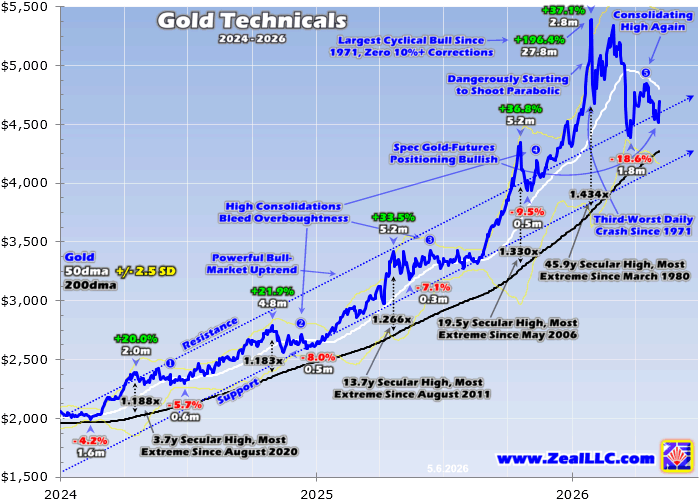
These collectively-remarkable high consolidations of recent years are readily apparent in this chart. Four times before during gold’s late monster record cyclical bull, episodes of extreme overboughtness were followed by drifts rather than plunges. And today’s high-consolidationy action is looking similar with gold remaining strong. All this together argues gold is revaluing into a new higher price regime going forward.
This chart subdivides gold’s late monster record bull and subsequent price action into big swings. They have been trending to bigger gold rallies to more-overbought extremes, which are followed by bigger drawdowns that are still more high-consolidation-like than real-selloff-like. All these sideways drifts are numbered. While one alone wouldn’t warrant an essay, potentially five in a row now is truly remarkable!
This all started into mid-April 2024, when gold surged 20.0% over 2.0 months. Peaking 18.8% above its 200dma, that was the most overbought gold had been in 3.7 years since August 2020. That earlier bull had ranked as gold’s then-17th-largest since 1971 at 40.0% in 4.6 months, and was followed by an 18.5% drawdown over 7.0 months. Yet gold rallied to new records in mid-May, then only pulled back 5.7% in 0.6 months.
From there gold blasted another 21.9% higher in 4.8 months into late October 2024. That wasn’t quite as overbought as the earlier peak, but still well into extreme territory then starting at 15% above its 200dma. Yet after that gold merely pulled back 8.0% in 0.5 months. Realize a sub-10% selloff is classified as a pullback, a 10%-to-20% one a correction, and 20%+ a new bear market. Gold remained super-resilient.
After that gold soared another 33.5% in 5.2 months into mid-April 2025, stretching fully 26.6% above its 200dma. That was the most-extreme overboughtness it had witnessed in 13.7 years, since way back in late August 2011. That was when gold’s 9th-largest cyclical bull since 1971 crested after soaring 78.3% in 18.5 months. The subsequent drawdown was a big-and-fast 14.9% in just 1.2 months, pretty serious.
Yet for the third time in a row, gold defied the odds and consolidated high. Gold edged up to a marginal new record close a couple weeks later, then merely pulled back 7.1% in 0.3 months. Unusual events in markets can usually be dismissed if isolated, but when patterns of them emerge that merits scrutiny. There has to be some underlying reason, and understanding that helps traders better game likely price action.
After that third high consolidation, gold soared again blasting up another 36.8% in 5.2 months into mid-October 2025. That stretched gold an immense 33.0% above its 200dma, the most overbought it had been in fully 19.5 years since mid-May 2006! That was when gold’s 6th-largest cyclical bull since 1971 had crested after soaring 92.3% in 23.9 months. It was followed by a brutal 21.9% drawdown in just 1.1 months!
Then I figured there was no way gold could escape a serious reckoning for the fourth consecutive time. Indeed right out of that peak, gold suffered a massive 5.3% down day which was its worst in 5.2 years and ranked in the top-0.3% across 54.8 years! Yet that total drawdown was soon truncated at a mere 9.5% loss in 0.5 months. With an amazing fourth high consolidation underway, high gold prices were enduring.
That was so contrary to all precedent we didn’t redeploy in gold-stock trades after our newsletter trading books were stopped out in late October. Though they still combined for 60 total stock trades in 2025 averaging fantastic +119.9% annualized realized gains, it was vexing watching gold soar again from the sidelines. Astoundingly by late January 2026, gold had rocketed another 37.1% in 2.8 months bringing us full-circle.
Again gold had skyrocketed an unbelievable 43.4% above its 200dma, making for that crazy 45.9-year high in overboughtness! Surely there was no way gold could evade a serious reckoning for the fifth time in a row out of such epic extremes. While that 13.3% crash in two trading days into early February formally slayed gold’s monster record cyclical bull, that might’ve been that selloff’s end without Trump’s war.
The resulting massive global economic dislocations from the Strait of Hormuz remaining closed are what spawned March’s big central-bank selling. Again maybe the resulting 18.6% gold selloff over 1.8 months will prove a sufficient reckoning for gold to resume powering higher on balance. It might just be close enough to that next-ten-largest gold-bull average drawdown of 20.8% over 2.1 months to rebalance herd sentiment.
While gold could still head lower, for now these technicals certainly argue gold is in its fifth high consolidation since its late monster record bull was born. That has a trading range running from late March’s closing low of $4,390 to late January’s parabolic peak of $5,394. We may as well round that to $4,400 to $5,400. Until gold breaks out decisively from this sideways drift in either direction, we can trade it.
As major gold stocks tend to amplify material gold moves by 2x to 3x and smaller mid-tiers and juniors more, they remain a great way to leverage gold trends. When high consolidations are established, I try to avoid buying gold stocks unless gold is in the lower quartile of its current range. Dividing this latest one into fourths yields break points of $4,641, $4,892, and $5,143. So sub-$4,640 gold is when to add positions.
Technically as evident in this chart, it is interesting gold’s two bounces in recent weeks both happened on the late monster record gold bull’s former upper resistance line. Old resistance becoming new support is a hallmark of prices revaluing higher. There are plenty of reasons prevailing gold prices ought to remain much higher in coming years than they were before that latest bull. Gold’s fundamentals are still strong.
Due to the inherent and increasing limitations in finding gold deposits and building mines to extract them, global gold mined supplies only increase on the order of 1% per year. According to the World Gold Council’s best-available gold fundamental data, over the past decade global gold mined supplies only grew an average of 1.3%. That has to be about an order of magnitude less than world money supplies!
With leading fiat currencies including the US dollar, euro, and yuan growing way faster than aboveground gold, that alone supports higher prevailing prices. If currencies are growing 10%, they double after just 7 years. Yet gold at 1% would take 70 years to double! Relatively-way-more currencies available to chase relatively-much-less gold certainly argues for a higher price regime. And investors’ gold allocations are small.
For example American stock investors’ portfolio allocations can be implied by the ratio between the total value of major-gold-ETF bullion holdings to the elite S&P 500 stocks’ collective market capitalization. Even as gold peaked in late January, the total value of GLD+IAU+GLDM’s gold was less than 0.5% of the S&P 500’s value! With Americans who dominate global capital flows uninvested in gold, vast demand is likely.
If their gold allocation doubles to a still-trivial 1% or quadruples to a tiny 2%, that demand will support much-higher gold prices for years to come. The lofty US stock markets at nosebleed valuations as the AI bubble rages on are almost certain to roll over into a severe bear sooner or later, which will really boost gold demand. Weakening stocks make investors remember the wisdom of diversification with essential gold.
The looming war inflation also supports robust gold demand in coming months. With the Strait of Hormuz being effectively shuttered for nearly 10 weeks now, the world is nearing 1b barrels of crude-oil supplies cumulatively lost! Resulting much-higher energy prices are pushing up general price levels globally, as everything physical transported requires refined oil. Fertilizer prices are also soaring, forcing up food prices.
Gold thrives in inflationary times, a prized store of value with hard-limited supply growth when general prices are inexorably climbing. The more investors suffer inflated prices in their own lives, the more likely they are to up their gold allocations. Gold also has shorter-term bullish factors including still-very-low long positioning among hyper-leveraged gold-futures speculators. A fifth high consolidation is certainly plausible.
Successful trading demands always staying informed on markets, to understand opportunities as they arise. We can help! For decades we’ve published popular weekly and monthly newsletters focused on contrarian speculation and investment. They draw on my vast experience, knowledge, wisdom, and ongoing research to explain what’s going on in the markets, why, and how to trade them with specific stocks.
Our holistic integrated contrarian approach has proven very successful, and you can reap the benefits for only $12 an issue. We extensively research gold and silver miners to find cheap fundamentally-superior mid-tiers and juniors with outsized upside potential. Sign up for free e-mail notifications when we publish new content. Even better, subscribe today to our acclaimed newsletters and start growing smarter and richer!
The bottom line is high gold prices are enduring. Despite gold recently skyrocketing to its most-extreme overboughtness in nearly a half-century, it has largely consolidated high since. War-related central-bank selling hammered gold down near an average post-monster-bull drawdown, establishing a high-consolidation trading range. If it holds, this will prove gold’s fifth high consolidation in a row in recent years.
That extraordinary streak argues gold is revaluing to a new higher price regime going forward. Global fiat-currency supplies are growing way faster than global aboveground gold supplies. And investors’ gold portfolio allocations remain incredibly low. So they have vast room to keep buying, which will accelerate on the looming stock-market bear and war inflation. Gold could very well again defy the odds to remain high.
Adam Hamilton, CPA May 8, 2026 Subscribe |
|||||||
|
|
|
|
|
|
|
|
|
|
|
|
|
|
|
|||