
Gold Mid-Tiers’ Q1’26 Fundamentals
Adam Hamilton May 22, 2026 3314 Words
Mid-tier and junior gold miners just finished reporting their sector’s best quarter in history by far. These smaller gold miners achieved spectacular results, shattering all records and greatly outperforming their larger major peers. The epic earnings deluging in left gold stocks trading at super-low valuations despite record prices. And with high prevailing gold prices enduring, gold miners’ astounding fundamentals will persist.
The leading mid-tier-gold-stock benchmark is the GDXJ VanEck Junior Gold Miners ETF. With $8.2b in net assets midweek, it remains the second-largest gold-stock ETF after its big-brother GDX. That is dominated by far-larger major gold miners, though there is much overlap between these ETFs’ holdings. Still misleadingly named, GDXJ is overwhelmingly a mid-tier gold-stock ETF with juniors having lesser weightings.
Gold-stock tiers are defined by miners’ annual production rates in ounces of gold. Small juniors have little sub-300k outputs, medium mid-tiers run 300k to 1,000k, large majors yield over 1,000k, and huge super-majors operate at vast scales exceeding 2,000k. Translated into quarterly terms, these thresholds shake out under 75k, 75k to 250k, 250k+, and 500k+. Today only five of GDXJ’s 25 biggest holdings are true juniors.
Their Q1 outputs are highlighted in blue in this essay’s table. Juniors not only mine less than 75k ounces per quarter, but gold output generates over half their quarterly revenues. That excludes streaming and royalty companies that purchase future gold output for big upfront payments helping finance mine-builds, and primary silver miners producing byproduct gold. But mid-tiers often make better investments than juniors.
These gold miners dominating GDXJ offer a unique mix of sizable diversified production, excellent output-growth potential, and smaller market capitalizations ideal for outsized gains. Mid-tiers are less risky than juniors, while amplifying gold uplegs more than majors. So we’ve long specialized in the fundamentally-superior mid-tiers and juniors at Zeal, actively trading these smaller gold miners for over a quarter-century now.
GDXJ had a wild ride in Q1, but still exited it a solid 5.5% higher. Through most of January, GDXJ soared 32.2% achieving 11 new all-time-record closes across just 18 trading days! As gold shot parabolic in a popular speculative mania, speculators and investors rushed into smaller gold miners. Yet when gold’s reckoning arrived with a brutal 10.3% single-day crash which was its third-worst daily loss since 1971, GDX cratered.
The mid-tiers plummeted 13.6% that day, extending two-day losses to 17.5% exiting January! By early February those extended to 19.4% amplifying gold’s parallel 10.8% loss. But as its metal recovered that month, GDXJ rocketed up another 28.9% into month-end racking up two more record closes! Then Trump launched his ill-fated war with Iran, and its disruptions fueled heavy central-bank gold selling in March.
So GDX collapsed another 32.9% over several weeks into late March, plunging way under early February’s initial low. From there it rebounded a strong 14.6% into quarter-end. Despite all that Q1 drama, GDJX averaged a record $130.61 on close last quarter which skyrocketed 159.0% YoY! Could fundamentals possibly justify such colossal gains? Q1’s results prove they aren’t just righteous, but still too small!
For 40 quarters in a row now, I’ve painstakingly analyzed the latest operational and financial results from GDXJ’s 25-largest component stocks. Mostly mid-tiers, they now account for 65.7% of this ETF’s total weighting. While digging through quarterlies is a ton of work, understanding smaller gold miners’ latest fundamentals really cuts through the obscuring sentiment fogs shrouding this sector. This research is essential.
This table summarizes the GDXJ top 25’s operational and financial highlights during Q1’26. These gold miners’ stock symbols aren’t all US listings, and are preceded by their rankings changes within GDXJ over this past year. The shuffling in their ETF weightings reflects shifting market caps, which reveal both outperformers and underperformers since Q1’25. Those symbols are followed by their recent GDXJ weightings.
Next comes these gold miners’ Q1’26 production in ounces, along with their year-over-year changes from the comparable Q1’25. Output is the lifeblood of this industry, with investors generally prizing production growth above everything else. After are the costs of wresting that gold from the bowels of the earth in per-ounce terms, both cash costs and all-in sustaining costs. The latter help illuminate miners’ profitability.
That’s followed by a bunch of hard accounting data reported to securities regulators, quarterly revenues, earnings, operating cash flows, and resulting cash treasuries. Blank data fields mean companies hadn’t disclosed that particular data as of the middle of this week. The annual changes aren’t included if they would be misleading, like comparing negative numbers or data shifting from positive to negative or vice-versa.
With Q1’s average gold price skyrocketing an epic 70.0% YoY to a record $4,873 per ounce, smaller gold miners’ results had to prove spectacularly-record-shattering. And they certainly didn’t disappoint. Back in early April way before any results, I predicted Q1 would prove gold miners’ best quarter ever by far. But surprising even me, it was so darned good it left the gold stocks deeply undervalued while at record highs!
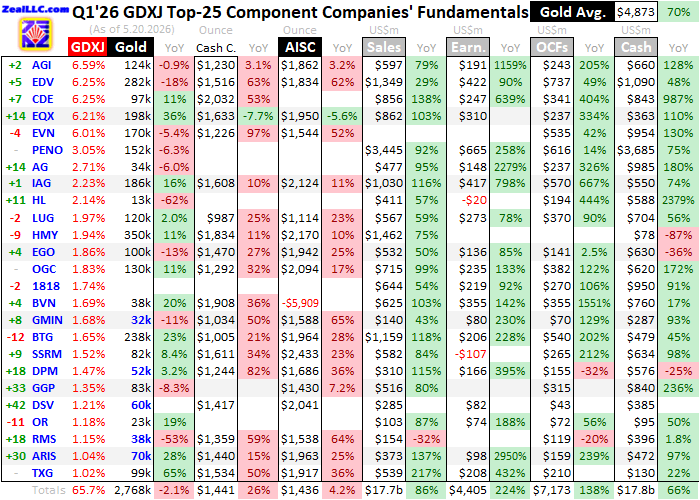
We have to start with some major composition changes in GDXJ’s upper ranks. First last quarter this ETF’s highest-weighted stock for the prior three quarters was booted, Pan American Silver. Now PAAS is exclusively in the larger GDX majors’ ETF, although it only mined 169k ounces of gold in Q1 which is still prime mid-tier-dom. And despite big silver output of 6,435k ounces, this company is still a primary gold miner.
There was also much shuffling in the GDXJ top 25’s lower ranks as gold-stock prices soared last quarter. DPM Metals, Greatland Resources, Discovery Silver, Ramelius Resources, and Aris Mining all catapulted way up in weightings over this past year. That’s great, leaving more juniors in the GDXJ top 25 than it has boasted in many years. Their market capitalizations used to be mostly-too-small for this ETF to buy in size.
This current GDXJ-top-25 lineup is among the best I’ve seen, with only two majors Endeavour Mining and Harmony Gold Mining left. I’ve long believed and argued GDX’s and GDXJ’s holdings should be mutually-exclusive, larger gold miners in the former and smaller ones in the latter. Yet every GDXJ-top-25 component is also in GDX, ranking from 11th to 37th with a 29.3% total weighting! GDXJ expands that to 65.7%.
Still GDXJ is a far-superior gold-miners ETF because GDX’s top-10 super-majors and majors are mostly deadweight. They operate at such vast scales they have long struggled to overcome depletion. And in addition to usually-declining production, their mining costs are generally rising and higher than many of the better mid-tiers’ and juniors’. So GDXJ not being burdened by them and heavily weighting mid-tiers is great.
In Q1’26 the GDXJ top 25’s total gold production slumped 2.1% YoY to 2,768k ounces. That proved way better than the GDX top 25’s steep 10.7%-YoY plunge to 7,230k. But as I explained in last week’s essay on the GDX top 25’s Q1’26 results, that was due to late Q1 reporting by HMY and the removal of a huge Chinese mining conglomerate from that ETF. Adjusted for those, the GDX top 25’s Q1 output grew 0.9% YoY.
If the same GDXJ-top-25 components from either Q1’26 or Q1’25 are compared, the mid-tiers and juniors achieved stronger output growth like usual. Breaking down that detailed analysis here would leave this essay way too long. But as an Australian-miners example, Ramelius Resources’ weighting surged to replace Perseus Mining in GDXJ’s upper ranks. RMS produced 38k ounces of gold in Q1’26, while PRU did 107k.
There are stories behind every gold stock surging to higher market caps and thus weightings in GDXJ and every one falling lower. Much of that has to do with production growth profiles based on mines and expansions. But in Perseus Mining’s case it has been burdened by terrible hedges forcing it to sell good chunks of is output radically below prevailing gold prices over this past year, which are being aggressively unwound.
Mid-tiers have always been superior to the majors. Running smaller stables of typically one-to-four gold mines, any sizable expansions or new mine-builds really move the needle to grow mid-tiers’ production. They not only easily overcome depletion unlike their larger peers, but consistently achieve sizable output growth as a group. Smaller gold stocks enjoy outsized gains around new expansions and mines coming online.
Production growth is essential in gold mining because it provides the cashflows necessary to continue expanding existing mines and building or buying new ones, ultimately driving stock prices higher. And surprisingly mid-tiers often have lower mining costs than majors, despite the latter’s supposed economies of scale. That makes mid-tiers much more profitable relative to their production, supporting bigger stock gains.
Also contributing to those is mid-tiers’ lower market capitalizations. The GDXJ top 25’s averaged merely $9.9b this week, well under 1/3rd of the GDX top 25’s $33.2b average last week! Generally the smaller any company’s market cap, the less inertia its stock price has and the less capital inflows needed to drive it higher. So when gold is powering higher fueling sector interest, mid-tiers and juniors really outperform.
Surprisingly global gold-mining output exhibits seasonality, with Q1s being the low ebb. The World Gold Council’s total global production plunged 8.6% from Q4’25 to Q1’26, right in line with the prior 15 years’ average 8.4% drop across these same two quarters! During that long span, that Q1 -8.4% average is followed by +4.9% quarter-on-quarter in Q2s, +6.2% in Q3s, and -0.0% in Q4s. Why are Q1s so weak?
That mainly has to do with northern-hemisphere winters. Over 2/3rds of this planet’s total landmass is found in its top half, along with a presumably-proportional amount of its gold production. Winter weather slows mining operations, from bitter cold up north to heavy rains down south reducing the efficiencies of chemical reactions necessary to recover gold from ores. That also impedes physically hauling those ores.
Unit gold-mining costs are generally inversely proportional to gold-production levels. That’s because gold mines’ total operating costs are largely fixed during pre-construction planning stages, when designed throughputs are determined for plants processing gold-bearing ores. Their nameplate capacities don’t change quarter-to-quarter, requiring similar levels of infrastructure, equipment, and employees to keep running.
So the primary variable driving quarterly gold production is the ore grades fed into these plants. Those vary widely even within individual gold deposits. Richer ores yield more ounces to spread mining’s big fixed expenses across, lowering unit costs and boosting profitability. But while fixed costs are the lion’s share of gold mining, there are also sizable variable costs. That’s where recent years’ raging inflation hit hard.
Cash costs are the classic measure of gold-mining costs, including all cash expenses necessary to mine each ounce of gold. But they are misleading as a true cost measure, excluding the big capital needed to explore for gold deposits and build mines. So cash costs are best viewed as survivability acid-test levels for smaller gold miners. They illuminate the minimum gold prices necessary to keep the mines running.
The GDXJ top 25’s average cash costs soared a record 25.9% YoY to a record $1,441 per ounce in Q1! That sounds bad, but it is heavily skewed by soaring royalty payments. Many gold miners have contracts in place requiring them to pay royalties, which are common when acquiring gold deposits and existing mines. As percentages of prevailing gold prices, these royalty-payments costs scale in proportion with gold.
Plenty of GDXJ-top-25 gold miners discussed higher royalty payments in their Q1 results, but IAMGOLD broke them out very clearly. IAG reported overall Q1 cash costs of $1,608, but also ex-royalties which were much lower at just $1,201. So its huge $407-per-ounce royalty payments last quarter accounted for 1/4th of its cash costs! Without royalties, smaller gold miners’ cash costs would’ve increased much less.
OceanaGold had another illustrative example, paying royalties at three of its four mines. From Q1’25 to Q1’26, those payments rocketed up 4.6x to $13.0m! Spread across the 130k ounces it produced last quarter, that added about $100 per ounce in cash costs. And cash costs are the lion’s share of broader AISCs, with the GDXJ top 25’s former averaging over 5/6ths of their latter during 2025’s four quarters.
All-in sustaining costs are far superior than cash costs, and were introduced by the World Gold Council in June 2013. They add on to cash costs everything else that is necessary to maintain and replenish gold-mining operations at current output tempos. AISCs give a much-better understanding of what it really costs to maintain gold mines as ongoing concerns, and reveal smaller gold miners’ true operating profitability.
Remarkably the GDXJ top 25’s AISCs only edged up 4.2% YoY to $1,436 in Q1’26! That utterly crushed the GDX-top-25 majors’ average which soared a record 24.9% YoY to a record $1,744, as analyzed in last week’s essay. Unfortunately the smaller gold miners’ wildly-superior mining costs are something of an illusion this time around, thanks to one crazy outlier. Peru’s Buenaventura reported negative $5,909 AISCs!
How is such sorcery possible? BVN is an unusual non-primary-gold miner still choosing to report in gold-centric terms, probably because gold stocks draw much more investor interest and capital than base-metals ones. While gold drove less than 1/3rd of Buenaventura’s Q1’26 revenues, this polymetallic miner still chooses to credit its collectively-much-larger silver, copper, zinc, and lead production as gold byproducts.
In Q1 one of BVN’s mines produced 23.8m pounds of copper, 608k ounces of silver, and such negligible gold it wasn’t even reported. Yet misleadingly this company reported that mine’s gold AISCs at -$42,936 per ounce! Madness I know, but I’ve always included all reported data in this research thread no matter how distorted some is. In the last 40 quarters, the vast majority of outlying AISCs have been high-side ones.
And BVN reporting super-low or negative AISCs is nothing new, it has happened in many quarters in recent years. Ex-Buenaventura in both comparable quarters, the GDXJ top 25’s average AISCs soared 22.2% YoY to a record $1,844 per ounce. That jump is largely royalty-driven, but also Q1’s usual lower-output ebb contributed. The GDXJ top 25’s average full-year-2026 AISC guidance is well lower at $1,762.
With average gold prices skyrocketing 70% YoY last quarter, royalty payments shooting up proportionally, and those being a big fraction of cash costs and thus AISCs, smaller gold miners’ record mining costs last quarter are totally reasonable. And they still rose far less than prevailing gold prices, allowing for huge earnings leverage to higher gold levels. The mid-tiers’ and juniors’ profitability in Q1 proved astonishing.
After my quarter-century-plus of intensely studying this sector, I’ve found the best metric for measuring gold miners’ collective fundamental performance is their implied unit earnings. That simply subtracts the GDXJ-top-25 average AISCs from the quarterly-average gold price. This is way cleaner than bottom-line accounting profits, since a varying GDXJ-top-25 subset’s are usually distorted by big noncash charges or gains.
Again in Q1’26 average gold prices enjoyed that stratospheric 70.0%-YoY gain to that stupendous record $4,873! Subtract the GDXJ top 25’s $1,436 average AISCs from that, and it yields jaw-dropping implied sector per-ounce profits of $3,437! That record catapulted an astounding 131.0% above Q1’25 levels! Even without BVN’s crazy anomaly, the rest of the GDXJ top 25’s still soared 103.5% YoY hitting a record $3,029.
If that was the whole story behind smaller gold stocks’ meteoric rise, it would be enough. But incredibly Q1’26 actually proved the 11th quarter in a row of enormous implied unit earnings growth. Starting way back in Q3’23, this metric soared 106%, 133%, 63%, 63%, 71%, 95%, 91%, 79%, 82%, 102%, and 131% YoY! With a windfall track record like that, mid-tiers and juniors ought to be one of the most-popular stock sectors.
And that magnificent streak ain’t over yet! Over halfway through this current Q2’26, gold is still averaging $4,681 despite the necessary reckoning after late January’s extreme topping and Trump’s Iran war. To be conservative, let’s say that plunges to $4,600 which would require much-lower gold prices into quarter-end. And let’s assume GDXJ-top-25 average AISCs this quarter come in on the higher side at $1,750.
Odds are they’ll prove considerably lower when reported from late July to mid-August. Again the GDXJ top 25’s average full-year AISC guidance is $1,762, and Q2s see that big 4.9% quarter-on-quarter output bounce from Q1s. That tends to proportionally drive down mining costs. Even using these unfavorable assumptions, this would combine for Q2’26 implied unit profits of $2,850 per ounce soaring another 49% YoY!
On to hard accounting results, the GDXJ top 25’s total revenues soared 86.3% YoY in Q1 hitting a record $17,732m! Bottom-line accounting earnings reported to securities regulators under Generally Accepted Accounting Principles or other countries’ equivalents skyrocketed 224.0% YoY to $4,405m! Yet that was not a record, as Q4’25’s weighed in at $5,150m. But without composition changes, Q1’26 would’ve been a record.
Had Pan American Silver remained in GDXJ, it alone would’ve contributed another $456m in earnings last quarter. Some of the new gold miners surging into the GDXJ top 25’s lower ranks also had lower production, sales, and profits than the components they displaced. Another factor was SSR Mining had a huge $338m writedown on selling a mine in Turkey where a heap-leach slide had tragically killed nine miners.
The gold miners’ accounting profits were so stellar they pummeled the GDXJ top 25’s average trailing-twelve-month price-to-earnings ratios down to just 16.9x this week! Those are the lowest smaller-gold-stock valuations by far witnessed in the past 40 quarters of this research thread. Gold stocks are cheaper today relative to underlying profits than they’ve been in at least a decade, despite trading near record-high prices!
The GDXJ top 25’s cash flows generated from operations soared 137.9% YoY to $7,173m, which was also slightly behind Q4’25’s record due to composition changes. These companies’ cash treasuries shot up 65.5% YoY to a record $17,752m, a colossal warchest they will use to finance more expansions and mine-builds to continue growing their production over time. Smaller gold miners’ fundamentals are epic.
They support and justify far-higher gold-stock price levels, as long as prevailing gold prices don’t plunge. And they’re not likely to as gold’s own fundamentals remain quite bullish, as I analyzed a couple weeks ago in an essay on high gold enduring. Gold is meandering on balance in another high-consolidation trading range. So when gold is in its lowest quartile, it’s logical to add fundamentally-superior smaller miners.
Successful trading demands always staying informed on markets, to understand opportunities as they arise. We can help! For decades we’ve published popular weekly and monthly newsletters focused on contrarian speculation and investment. They draw on my vast experience, knowledge, wisdom, and ongoing research to explain what’s going on in the markets, why, and how to trade them with specific stocks.
Our holistic integrated contrarian approach has proven very successful, and you can reap the benefits for only $12 an issue. We extensively research gold and silver miners to find cheap fundamentally-superior mid-tiers and juniors with outsized upside potential. Sign up for free e-mail notifications when we publish new content. Even better, subscribe today to our acclaimed newsletters and start growing smarter and richer!
The bottom line is smaller mid-tier and junior gold miners just reported the best quarter in the history of gold mining. Last quarter’s epic record-shattering gold prices fueled record-shattering revenues, bottom-line earnings, unit profits, operating cash flows, and cash treasuries for the smaller gold miners. And this was actually their 11th quarter in a row achieving skyrocketing unit earnings, an epic unparalleled growth streak.
And it isn’t over yet with gold consolidating high in this over-half-done Q2. High gold prices are enduring for the metal’s own strong fundamental reasons, portending way-bigger gold-miner earnings in coming years than past ones. Despite soaring with their metal in recent years, gold stocks still need to continue revaluing higher to reflect their stellar fundamentals in this gold regime. Their huge bull run looks far from over.
Adam Hamilton, CPA May 22, 2026 Subscribe at www.zealllc.com/subscribe.htm
