
Gold Summer Doldrums ‘26
Adam Hamilton June 5, 2026 2706 Words
Early summers are the weakest season of the year for gold and its miners’ stocks. Traders’ interest in markets wanes, with vacations and summer fun diverting their attention. That usually weighs on gold’s investment demand, often leaving its price drifting sideways to lower. Typically June is the heart of these summer doldrums, with buying tending to return by mid-July. So this time of year is good for building positions.
This doldrums term is very apt for gold’s usual summer predicament. It describes a zone in the world’s oceans surrounding the equator. There hot air is constantly rising, spawning long-lived low-pressure areas. They are often calm, with little prevailing winds. History has accounts of sailing ships getting trapped in this zone for days or weeks, unable to make headway. The doldrums were murder on ships’ morale.
Crews had no idea when the winds would pick up again, while they continued burning through their limited stores of food and drink. Without moving air, the stifling heat and humidity were suffocating on those ships long before air-conditioning. Misery and boredom grew extreme, leading to fights breaking out and occasional mutinies. Being trapped in the doldrums was viewed with dread, it was a trying experience.
Gold investors can somewhat relate. Like clockwork trudging through early summers, gold usually starts drifting listlessly sideways. It often can’t make significant headway no matter what trends looked like heading into June, July, and August. As the days and weeks grind on, sentiment deteriorates markedly. Patience is slowly exhausted, supplanted with mounting frustration. So plenty of traders abandon ship, capitulating.
June and early July in particular have often proven desolate sentiment wastelands for gold and gold stocks, devoid of recurring seasonal demand surges. Unlike most of the rest of the year, the summer months simply lack any major income-cycle or cultural drivers of outsized gold investment demand. Seasonals aside, gold’s setup heading into summer 2026 is actually pretty bullish after recent months’ wild action.
Through most of January alone, gold skyrocketed 25.1% in a popular-speculative-mania climax to its biggest cyclical bull ever in dollar terms! That clocked in with spectacular 196.4% gains over 27.8 months without a single 10%+ correction! Late January’s terminal record close was stretched 43.4% above gold’s baseline 200-day moving average, the most overbought gold had been since March 1980 fully 45.9 years earlier!
Such crazy extremes demanded a reckoning to rebalance sentiment and technicals. In early February I warned about this, analyzing the aftermaths following dollar gold’s biggest cyclical bulls ever. The next-ten-largest averaged subsequent big-and-fast drawdowns of 20.8% in 2.1 months! With gold not far under late January’s $5,394 record I wrote, “A similar 20% one today would hammer gold near $4,315 by late March!”
That proved prescient, as gold plunged to $4,390 in late March extending its total drawdown to a serious 18.6% in 1.8 months. Those two extremes defined a high-consolidation trading range for gold in which it has been meandering since. High gold is enduring despite the backward war trade, with huge progress made in rebalancing gold since late January’s peak. Midweek it had retreated to just 1.1% above its 200dma.
That’s was gold’s least-overbought close in fully 2.6 years, since mid-November 2023 early in gold’s late monster record bull! So gold is entering 2026’s summer doldrums with January’s froth all beaten out. That really reduces the odds gold will suffer a significant selloff this month, and really ramps the likelihood gold’s subsequent autumn rally will prove strong. The less overbought gold is entering June, the better it fares.
I’ve been working on this summer-doldrums research thread for decades now, and restrict this analysis to bull-market years for gold. Its technical behaviors are quite different in bull and bear years. In the entire quarter-century span from 2001 to 2026, all years qualified as bull ones except 2013 to 2015. From October 2012 to December 2015, gold was gradually mauled 41.3% lower in a vexingly-tenacious secular bear.
But the 22 years surrounding that were bull years. From April 2001 to August 2011 gold powered 640.1% higher, then from December 2015 to January 2026 it climbed another great 413.2%! Across that entire 24.8-year span including that obstinate bear, gold soared 21.0x higher! Despite Wall Street’s hate for gold, that crushed the S&P 500’s mere 6.1x gains in that same long span. Gold has proven a champion investment.
Quantifying gold’s summer seasonal tendencies during bull markets requires all relevant years’ price action to be recast in perfectly-comparable percentage terms. That is accomplished by individually indexing each summer’s gold prices to their last closes before, which are May’s final trading days. They are set to 100, then all summer gold price action is recalculated off those common indexed baselines.
So gold trading at an indexed level of 110 simply means it has rallied 10% from May’s final close, while 95 shows it is down 5%. This methodology renders all bull-market-year gold summers in like terms. That’s necessary since gold’s price range has been so vast, from $257 in April 2001 to that $5,394 in January 2026. Looking at percentage changes instead of price ones is the only way to distill such dissimilar data.
When all gold’s summer price action from these modern gold-bull years is individually indexed and thrown into a single chart, this spilled-spaghetti mess is the result. 2001 to 2012 and 2016 to 2024 are rendered in yellow. Last summer’s action is shown in light-blue for easier comparison with this summer. Seeing all this perfectly-comparable indexed summer price action at once reveals gold’s center-mass-drift tendency.
These summer seasonals are further refined by averaging together all 22 of these gold-bull years into the red line. Finally gold’s summer-to-date action this year is superimposed over everything else in dark-blue, showing how gold is performing compared to its seasonal precedent. Due to that backward war trade, gold’s early-summer action this year has proven quite weak yet still well within summer-doldrums-drift norms.
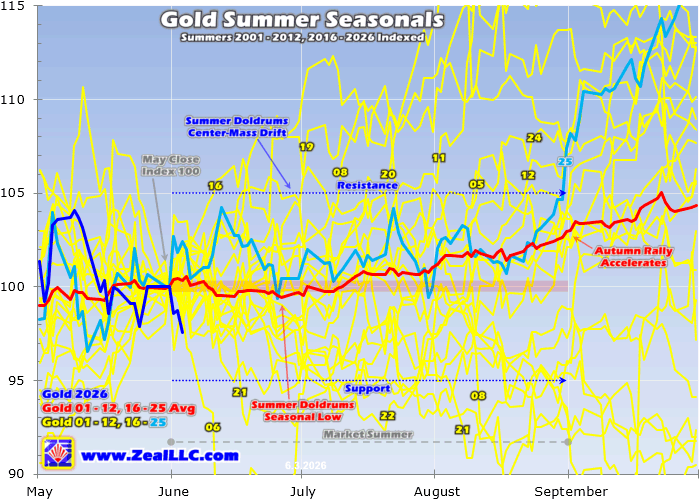
As of midweek, gold had plunged 2.4% during this market summer’s first three trading days. On average during these past bull years it was up 0.3% at this point. That divergence resulted from gold’s backward war trade. I wrote a whole essay last week analyzing that in depth. In a nutshell gold is selling off when Trump’s war with Iran intensifies, then rallying on peace-deal-imminent hopes which Trump loves to stoke.
This odd dynamic arose in mid-March on heavy central-bank selling led by Turkey, which faces a serious war-fueled crisis. That long-troubled country not only imports 9/10ths of its crude oil and oil products, but suffers from terrible inflation and an endlessly-falling currency. Turkey tried to intervene dumping gold to buy its lira, which still plunged to record lows. That hammered gold 14.9% lower in just eight trading days!
Since then traders have treated flaring US-Iran hostilities as bearish for gold, which is dumbfounding. The longer Trump’s war lasts, the longer the critical Strait of Hormuz is effectively closed, the more bullish gold’s outlook gets. Mostly pinching off 1/5th of both the world’s oil and LNG trades, and 1/3rd of its seaborne fertilizer trade, portends serious inflation looming. Higher prices are bullish for gold investment demand.
That’s always been true. During the 1970s in the last oil shock which was way smaller than today’s, gold skyrocketed 24.3x in 10.0 years! Since gold’s global mined-supply growth is only about 1% annually, its prices at least pace and usually well outperform inflation. Higher general prices also indirectly boost gold investment demand by weakening stock markets. Inflation erodes discretionary spending and corporate earnings.
So realize gold’s recent Iran-war-is-bearish behavior will prove a short-lived anomaly. Without the record drain in global crude-oil and oil-products stockpiles, energy prices would’ve soared much higher. And by all accounts from oil-industry top executives worldwide, those draws will soon dwindle dramatically as storage increasingly threatens operational minimums. Then the full inflationary impact of this war will be felt.
Gold’s summer doldrums mostly in June are part of a larger seasonal pattern. During these same modern bull years, gold has enjoyed big autumn, winter, and spring seasonal rallies. These are fueled by well-known income-cycle and cultural drivers of outsized gold demand from around the world. Early summers are the longest lull between these seasonal rallies, which often makes June a good time to add positions.
In seasonal-average terms, gold’s summer doldrums have actually proven quite mild. On average at its seasonal low in late June, gold has only been down 0.6% across these 22 years. That low births gold’s autumn rally, which doesn’t really start picking up steam until mid-July. In 2001 to 2012 and 2016 to 2025, that averaged sizable 5.5% gains into late September. That’s soon followed by gold’s better winter rally.
That tends to run into late February averaging 7.9% gains, and then a smaller spring rally takes over into early June up 4.3%. These summer doldrums are the starting point for gold’s whole seasonal cycle. So as long as gold is not extremely overbought heading into June, traders’ lack of interest this time of year offers good seasonal buying opportunities in gold and its miners. This summer looks more bullish than most.
Impressively the looming war inflation is merely one part of that. Gold’s short-term price action is often overwhelmingly driven by super-leveraged gold-futures trading. So speculators’ positioning there is very important for gold’s likely near-future direction. In particular these traders’ collective upside bets or longs are often gold’s primary driver. Those are actually incredibly low right now given gold’s enduring high prices.
Partially due to gold’s backward war trade recently, total spec longs fell to just 247.9k contracts in their latest weekly report. Astoundingly that’s a 3.5-year secular low, these traders’ smallest upside bets on gold since late November 2022! That was almost a year before gold’s late monster record bull was even born, when gold was trading near $1,749. So specs now have vast room to buy, chase, and amplify gold rallies.
American investors also have barely any portfolio allocations in gold. They’ve been distracted by the AI stock bubble, which is overdue to burst and roll over into a serious bear. Every day contrarian analysts are highlighting new extremes across valuations and technicals not seen since the dot-com bubble or ever. AI stocks and everything adjacent led by semiconductors have skyrocketed to wildly-unsustainable extremes.
Euphoric stock-bubble toppings really impair gold investment demand, because investors enamored with the bubble sectors forget the wisdom of prudent portfolio diversification. But all bubbles inevitably fail, and the subsequent serious stock-market selloffs rekindle neglected gold investment demand. And American stock investors’ implied gold portfolio allocations still round to zero, so they have colossal room to buy.
One proxy for this compares the total value of physical bullion stored in the globally-dominant American GLD, IAU, and GLDM gold ETFs with the total market capitalization of all S&P 500 stocks. As of midweek that gold held in trust for American stock investors was worth $244.8b. Yet that was only 0.36% of the value of S&P 500 stocks, implying one-third-of-one-percent gold portfolio allocations! That should go way higher.
Something is going to pop this AI bubble, and likely soon. Maybe it will be the looming war inflation hitting corporate earnings as the majority of Americans increasingly struggle to pay for life’s necessities. It could be surging US Treasury yields competing against these super-risky stock markets, driven by bond investors’ mounting worries about the US government’s profligate deficit spending and mind-boggling debt load.
It could be one of this year’s enormous IPOs flopping. SpaceX will be the first and a record, listing with a stupendous $1,750b valuation. But that is nearly 94x 2025’s revenues, almost doubling the 49x IPO average in 2000 as the dot-com bubble peaked! When these insane stock markets roll over and threaten a bear, gold investment demand will surge if not soar. Investors will need to diversify their tech-heavy portfolios.
Gold’s bullish outlook after 2026’s summer doldrums is more bullish for its miners’ stocks. The major gold miners of the leading GDX gold-stock ETF tend to see their earnings and thus stock prices amplify material gold moves by 2x to 3x. Thus they exaggerate gold’s seasonal cycle proportionally. This chart uses the older HUI gold-stock index, as GDX was born in May 2006 so its history doesn’t span all these bull years.
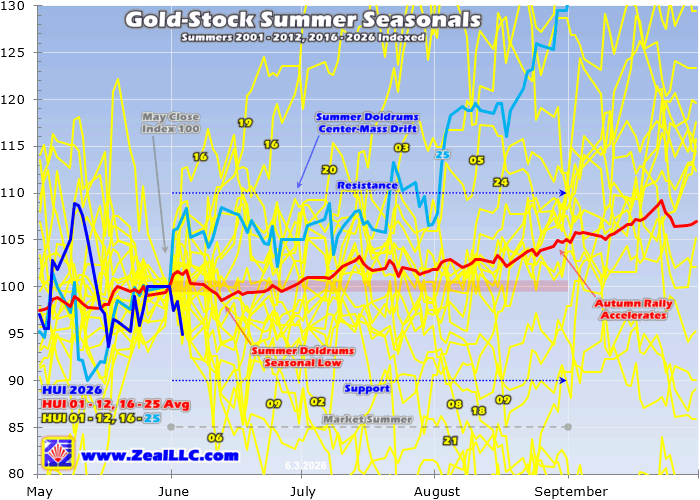
Thanks to gold’s big 2.4% summer-to-date loss, GDX has plunged 5.0% as of midweek. Though a weak start for a market summer, that’s still well within gold stocks’ center-mass drift. In these 22 bull years the HUI, which is functionally interchangeable with GDX containing mostly the same gold miners at similar market-cap-driven weightings, has tended to bottom in mid-June down just 1.5% from its levels entering summer.
On average the gold stocks have edged up 0.4% in June, rallied 1.4% in July, then accelerated to bigger 3.2% gains in August as gold’s autumn rally gathers steam. That compares to gold slipping 0.3% in June, climbing 1.3% in July, then surging 1.9% in August. June into early July is increasingly proving the extent of the summer doldrums in these modern gold-bull years. So the seasonal window to add gold stocks is narrow.
All the bullish factors for gold in coming months also apply to its miners’ stocks since they leverage their metal’s gains. But gold stocks also bring some of their own to the table. Midweek GDX fell 1.1% under its 200dma, the least overbought gold stocks had been in 16.6 months since mid-January 2025. From there into late February 2026’s latest record close, this ETF more than tripled soaring another 218.9%!
After every quarterly earnings season, I do a deep dive into the top 25 GDX components’ latest results. Several weeks ago I wrote an essay on how they fared in Q1’26. Thanks to record gold prices, the GDX top 25 reported epic record sales and profits. Their bottom-line earnings were so enormous that their average trailing-twelve-month price-to-earnings ratios in mid-May fell to their lowest levels in at least a decade!
With many trading at really-low multiples in the low-teens and even single-digits, gold stocks are actually still really undervalued relative to their underlying profits. So as long as gold continues consolidating high on balance or resumes powering higher, the gold miners’ enormous earnings justify much-higher stock prices ahead. And like gold, American stock investors’ gold-stock allocations also remain incredibly low.
So we’ve been gradually rebuilding the trading books in our subscription newsletters, adding gold stocks when gold is in the lower quartile of recent months’ high consolidation. For over a quarter-century we’ve specialized in trading smaller fundamentally-superior mid-tier and junior gold miners. They tend to well outperform the majors dominating GDX. Gold stocks are poised for big gains as gold’s next upleg gets underway.
Successful trading demands always staying informed on markets, to understand opportunities as they arise. We can help! For decades we’ve published popular weekly and monthly newsletters focused on contrarian speculation and investment. They draw on my vast experience, knowledge, wisdom, and ongoing research to explain what’s going on in the markets, why, and how to trade them with specific stocks.
Our holistic integrated contrarian approach has proven very successful, and you can reap the benefits for only $12 an issue. We extensively research gold and silver miners to find cheap fundamentally-superior mid-tiers and juniors with outsized upside potential. Sign up for free e-mail notifications when we publish new content. Even better, subscribe today to our acclaimed newsletters and start growing smarter and richer!
The bottom line is gold has entered 2026’s summer doldrums, its weakest time of the year seasonally. Typically most of that slump is compressed into June and early July, with gold’s autumn rally generally getting underway by mid-July. June’s lull comes before gold’s sequential seasonal autumn, winter, and spring rallies, making early summer a good time to add positions. This year’s doldrums setup is quite bullish.
Gold just fell to its least-overbought levels in the better part of several years. Its recent high consolidation has rebalanced away late January’s extreme sentiment and technicals. Gold-futures speculators and American stock investors both have big room to buy and chase gold accelerating coming upside. Looming war inflation and the AI stock bubble bursting ought to rekindle big investment demand fueling another upleg.
Adam Hamilton, CPA June 5, 2026 Subscribe at www.zealllc.com/subscribe.htm
